Generative AI is changing how digital content gets made—and you don’t need a technical background to benefit from it. It refers to AI systems that can create new text, images, audio, and video from simple prompts, helping creators and businesses produce high-quality work faster than ever before.
From drafting blog posts to designing visuals and personalizing campaigns, generative AI is reshaping workflows across every industry. In this article, we’ll explain what generative AI is, how it’s transforming digital content, and practical ways to start using it today—no hype, just clear, actionable guidance.
Introduction
Generative AI has moved from research labs into everyday creative workflows faster than almost any technology in recent memory. Tools that once seemed like science fiction—writing assistants that draft entire articles, image generators that produce photorealistic scenes from a single sentence, and music models that compose original scores—are now accessible to anyone with a browser. For content creators, marketers, publishers, and small business owners, understanding what this technology is and how it changes digital content is no longer optional. It is a practical necessity.
This article explores What Is Generative AI and How Is It Transforming Digital Content with clear, practical guidance. Rather than treating the topic as a futuristic curiosity, we will break it down into plain language, explain the underlying concepts, examine how it is reshaping the way content is produced and consumed, and offer a step-by-step approach you can follow. Whether you are drafting your first AI-assisted blog post or deciding how to integrate these tools into a team workflow, the goal is the same: to help you move from curiosity to confident, informed use.
The pace of change can feel overwhelming, but the fundamentals are more stable than the headlines suggest. Once you understand the core ideas—how these models work, what they are good at, and where they fall short—you can evaluate new tools and trends without starting from scratch each time. That is the foundation this guide aims to give you.
Key Concepts
Before diving into transformation and tactics, it helps to establish a shared vocabulary. Generative AI refers to a class of artificial intelligence systems that create new content—text, images, audio, video, or code—rather than simply classifying or analyzing existing data. Traditional AI might sort your email into categories; generative AI writes the reply.
At the heart of most modern generative systems are large language models and diffusion models. Large language models predict the next word in a sequence, trained on vast amounts of text, which allows them to produce coherent paragraphs, answer questions, and summarize documents. Diffusion models, used heavily in image generation, learn to remove noise from data step by step, eventually producing a clean, original image from a text prompt.
- Prompt: The instruction or input you give the AI. Clear, specific prompts produce better results.
- Training data: The material a model learned from. It shapes what the model knows and the biases it may carry.
- Hallucination: When a model confidently states something false. This is a key reason human review remains essential.
- Multimodal: Models that work across more than one type of content, such as text and images together.
- Fine-tuning: Adapting a general model to a specific task or brand voice using additional examples.
Understanding the fundamentals of What Is Generative AI and How Is It Transforming Digital Content helps you make informed decisions. When you know that a model generates plausible text rather than verified facts, you naturally build verification into your workflow. When you understand that outputs depend on prompts, you invest more effort in crafting them. These small shifts in understanding pay off in quality and risk management.
It is also worth distinguishing generative AI from earlier automation. Spreadsheet macros and email templates follow fixed rules. Generative models work probabilistically, producing different results each time. That variability is both the tool’s strength—flexibility and creativity—and its challenge, since it demands more oversight and testing.
Deep Dive
The transformation of digital content is happening across several dimensions at once. The most visible is speed. Tasks that once took hours—drafting social posts, writing product descriptions, creating thumbnail concepts—can now be done in minutes. But speed alone undersells the shift. Generative AI changes who can create content, how it is personalized, and how much of the production pipeline can be automated.
Consider personalization. Brands can now generate variations of marketing copy tailored to different audience segments at a scale that was previously impractical. E-commerce sites can produce unique descriptions for thousands of products. Media companies can summarize long reports or translate content into dozens of languages. Each of these applications follows the same pattern: the AI handles the repetitive, high-volume production, while humans set strategy, review quality, and add judgment.
Yet transformation comes with real trade-offs. Content saturation is one. When anyone can produce large volumes of text and imagery quickly, standing out requires more originality and stronger editorial standards, not less. Authenticity becomes a differentiator. Audiences increasingly value human perspective, lived experience, and clear expertise.
There are also legal and ethical considerations. Questions around copyright, training data, disclosure of AI-generated content, and accuracy are actively evolving. Responsible practitioners stay informed, follow platform policies, and disclose AI use where appropriate. The organizations that handle this transition best tend to treat generative AI as an assistant rather than a replacement, keeping humans firmly in the loop for anything published under their name.
Another practical reality is that generative AI reshapes job roles as much as it reshapes content. Writers spend more time editing and directing, designers focus on concepts and curation, and editors become quality gatekeepers for machine-generated drafts. Teams that invest in these evolving skills—prompt design, fact-checking, editorial judgment—adapt faster than those that simply bolt a tool onto an unchanged process.

Best Practices
Getting good results from generative AI is less about finding a magic tool and more about consistent habits. Reliable information and consistent habits lead to better long-term outcomes. These practices apply whether you are a solo creator or part of a larger content team.
- Always verify facts. Treat AI output as a draft. Check names, numbers, quotes, and claims against trustworthy sources before publishing.
- Write specific prompts. Include audience, tone, format, length, and any constraints. Refine iteratively rather than expecting perfection on the first try.
- Keep a human voice. Edit generated text to match your brand, add original insight, and remove generic phrasing.
- Protect sensitive data. Avoid pasting confidential information into tools whose data handling policies you have not reviewed.
- Disclose when appropriate. Follow the norms of your platform or industry and be transparent with your audience and clients.
- Document your workflow. Record prompts, tools, and review steps so results are repeatable and accountable.
Beyond individual habits, establish a simple review process. A two-pass system—one editor for accuracy, one for voice and style—catches most issues before they reach your audience. For teams, a shared prompt library and style guide helps keep AI-assisted output consistent across contributors. These practices cost little, but they dramatically reduce the risk of publishing errors or off-brand content.
Step-by-Step Guide
If you want to put this knowledge into action, follow this practical sequence. It works for individuals and teams alike and can be adapted to nearly any content type.
Step 1: Understand the fundamentals
Start by learning how generative AI models work at a basic level—what they can do, what they cannot, and why outputs vary. Read official documentation for the tools you plan to use and note their limitations and data policies. This baseline knowledge prevents common mistakes and helps you judge vendor claims realistically.
Step 2: Assess your starting point
Review your current content process. Identify which tasks are repetitive and time-consuming, such as drafting outlines, writing product descriptions, or creating social captions. Note your team’s skills, existing tools, and any compliance requirements. A clear picture of where you are today makes it easier to choose where AI can genuinely help.

Step 3: Set clear goals
Define what success looks like. Are you trying to produce more content, improve turnaround time, cut costs, or free up time for higher-value work? Set measurable targets, such as reducing draft time by a set percentage or increasing output volume while maintaining quality checks. Specific goals keep adoption focused and prevent the technology from becoming a solution in search of a problem.
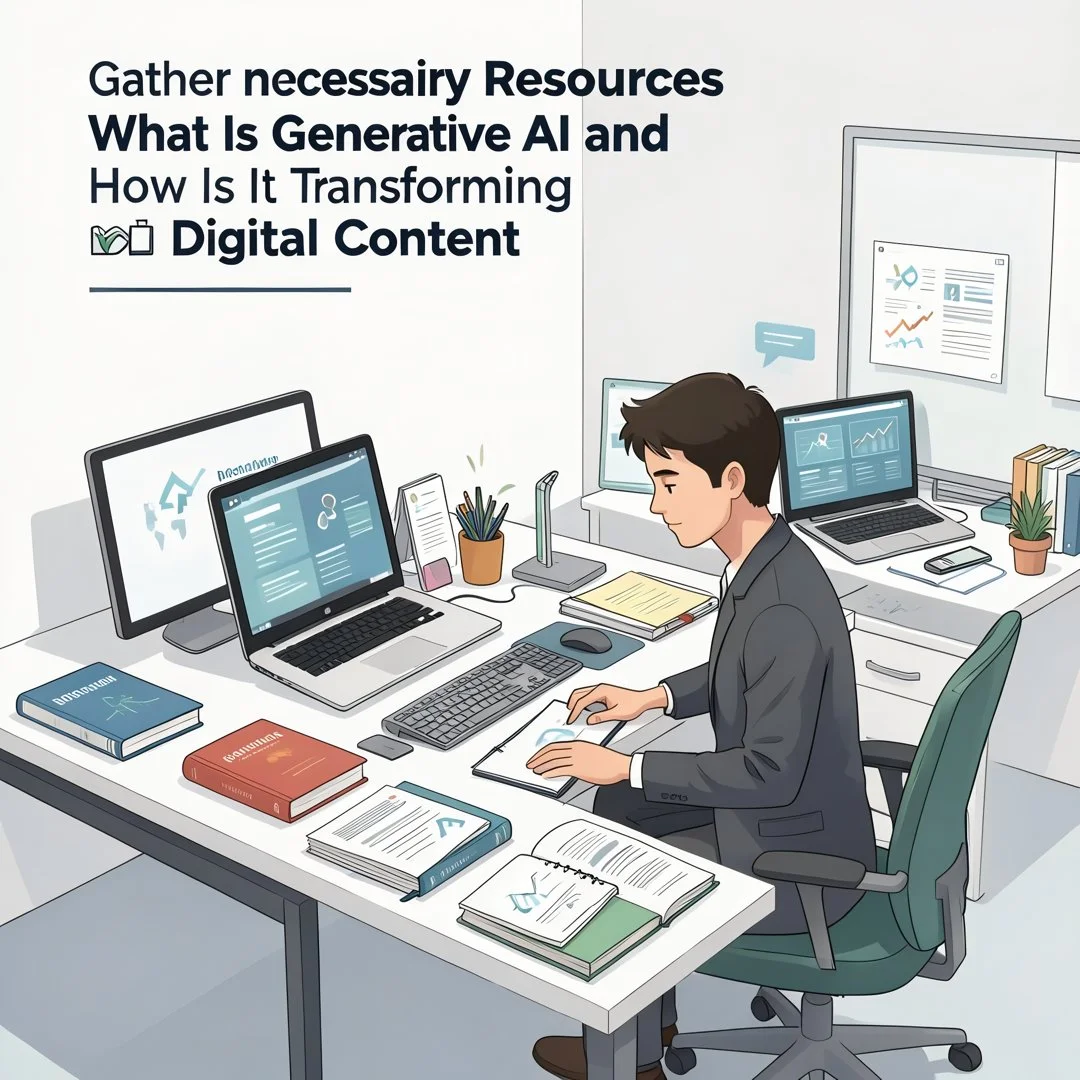
Step 4: Gather necessary resources
Choose tools that fit your budget and needs, starting with free tiers where possible. Prepare reference materials—brand guidelines, style guides, and approved source lists—that you can supply to the AI for better results. Confirm that your team has the training time and that data privacy requirements are met before rolling anything out.
Step 5: Apply the core methods
Begin with low-risk, high-volume tasks such as brainstorming, outlining, and first drafts. Use specific prompts and keep humans in the loop for editing and fact-checking. Establish a review process, create a shared prompt library, and document what works. Expand gradually to more complex tasks only after early results and safeguards are proven.

Step 6: Monitor your progress
Track results against the goals you set. Measure time saved, quality indicators, audience engagement, and error rates. Gather feedback from your team and audience. Revisit your tools and prompts regularly, since models and best practices change quickly. Adjust your approach based on evidence, not hype.
FAQ
What should I know about What Is Generative AI and How Is It Transforming Digital Content?
The most important things to understand are that generative AI creates new content from patterns in training data, that it can produce impressive but occasionally inaccurate output, and that human review remains essential. It is transforming digital content by speeding up production, enabling personalization at scale, and lowering barriers to entry—while also raising the bar for originality, authenticity, and editorial quality. Reliable information and consistent habits lead to better long-term outcomes, so pair curiosity with verification.
Who is this guide for?
This guide is for anyone who creates, manages, or evaluates digital content—writers, marketers, small business owners, publishers, students, and team leads exploring AI tools. It assumes no technical background and focuses on practical understanding and actionable steps. If you want clear guidance on what generative AI is and how to use it responsibly in your content work, it is written for you.
Conclusion
Generative AI is genuinely reshaping digital content, but the transformation is most successful when guided by understanding rather than urgency. By grasping the fundamentals, adopting consistent review habits, and following a structured rollout, you can capture the speed and scale benefits while protecting quality and trust. The tools will keep changing; the principles of clear goals, human judgment, and reliable verification will not. Start small,.
You now have a solid foundation for What Is Generative AI and How Is It Transforming Digital Content. Apply the best practices above and revisit this guide as your needs evolve.