Quick answer: Tesla’s Optimus humanoid robot is still an internal Tesla program in October 2026. You cannot buy one and Tesla has published no official price. On October 21, 2026, Tesla said it had started early production on its high-volume Optimus line in Fremont, but it gave no output numbers. Elon Musk has also said robot hands and a magnet supply shock slowed the project.
Every few weeks a new headline claims Optimus is “in mass production” or “available now.” Most of those claims fall apart when you check Tesla’s own statements. This guide separates what Tesla has actually said from what content farms keep repeating, so you know where the project really stands today.
Last updated: November 1, 2026. Nothing here is financial advice.
Tesla’s Optimus Humanoid Robot at a Glance
| Question | Verified answer (Oct 2026) |
|---|---|
| Can you buy it? | No. No public sale, pre-order or official price. |
| Where is it built? | Early production began at Fremont, California (Tesla, Oct 21, 2026). A Texas facility is under construction. |
| Public availability target | Musk says late 2027. Tesla has not confirmed it. |
| Long-term price target | Roughly $20,000 to $30,000 at huge scale. Not a real price today. |
| Hardest problem | Hands: precision and force at the same time. |
| Next checkpoint | Tesla’s Q4 earnings report, expected in early 2027, for the first real production numbers. |
Fact 1: Optimus Is Not for Sale Yet
Searches like “Tesla Optimus for sale” and “where to buy Tesla Optimus” keep climbing, but there is nothing to buy. Tesla has not opened orders, a waiting list or a price sheet. Any website selling a “Tesla Optimus Gen 3” is either a toy, a figurine or a scam.
The robot has been shown since 2022, when Tesla revealed an early prototype at AI Day. Tesla described that first design as about five feet eight inches tall and roughly 125 pounds. Since then the program has moved through several redesigns, but it has never shipped to outside customers.
Fact 2: Production Has Started, but Only in Early Ramp
At its first-quarter 2026 earnings call, Tesla said first-generation Optimus production lines were being installed at Fremont, designed for up to one million robots a year. It also described a second-generation line at Gigafactory Texas, designed for up to ten million a year in the long run, starting in 2027, according to the Wikipedia summary of Tesla’s reports.
Those are design capacities, not output. On October 21, 2026, alongside its third-quarter results, Tesla said it had begun production on the high-volume Optimus line at Fremont. Its earnings materials describe the ramp as “Early Ramp,” and Musk called it early production with a shallow, bumpy slope. Tesla did not disclose production or sales volumes, and it still points to internal use first, not retail sales. A reported internal target of more than 1,000 robots a week by the end of 2026 has circulated, but Tesla has not published confirmed production numbers.
Fact 3: Robot Hands Are the Bottleneck
Speaking at the X Takeover event at Giga Texas on October 11, Musk called the hand problem “shockingly difficult”, according to Teslarati’s report. His point was simple. A humanoid needs fine control and real strength together, such as driving a small screw into wood, while touch sensors must survive huge numbers of cycles without wearing out.
That matters for buyers. A robot that walks well but cannot grip reliably is a demo, not a household helper. Hands decide whether Optimus does useful work or just looks impressive on video.
Fact 4: A Magnet Export Ban Cost Months
Musk also said China’s export limits on magnets used in electric motors delayed the program by two to three months. Those magnets sit inside the small actuators that move a robot’s arms and fingers. His fix is to build the supply chain domestically, which is slow because robots, unlike cars, have no ready-made parts ecosystem.
He expects the early production ramp to be very slow before it accelerates. That is a more cautious tone than earlier timelines, and it is worth remembering when you read bold forecasts for 2027.
Fact 5: The $20,000 to $30,000 Price Is a Goal, Not a Quote
You will often see “Optimus price: $30,000” in headlines. That figure comes from Musk’s long-term target for a robot built in enormous volumes. Tesla has never published an actual price for Optimus Gen 3 or V3.
Early units will almost certainly cost far more to make, and Tesla plans to use the first robots in its own factories. Treat any exact price as speculation until Tesla posts one.
Fact 6: Gen 3 and V3 Are Used Loosely
The names confuse people. Some outlets use “Gen 3” for the newest hand design, while “V3” usually means the redesigned production-ready body. In April 2026, Musk said the Gen 3 version would be unveiled closer to when production starts, so a full public reveal has been repeatedly pushed back.
For anyone searching “Tesla Optimus Gen 3 release date,” the honest answer is that no official date exists. Watch Tesla’s earnings calls and official X account instead of third-party blogs.
Fact 7: Demos Are Not Proof of Autonomy
At the 2024 “We, Robot” event, several Optimus interactions were later reported to be partly teleoperated. In January 2026, Musk himself said the robots were not yet doing material work in Tesla’s factories. This week he went further and said any complicated robot demo can be canned, meaning pre-scripted, and that true intelligence means coping with something the robot has never seen.
That is a fair standard, and it applies to Tesla too. When you watch a clip, ask three questions: Was it autonomous? Was it live? Could it repeat the task in a new place?
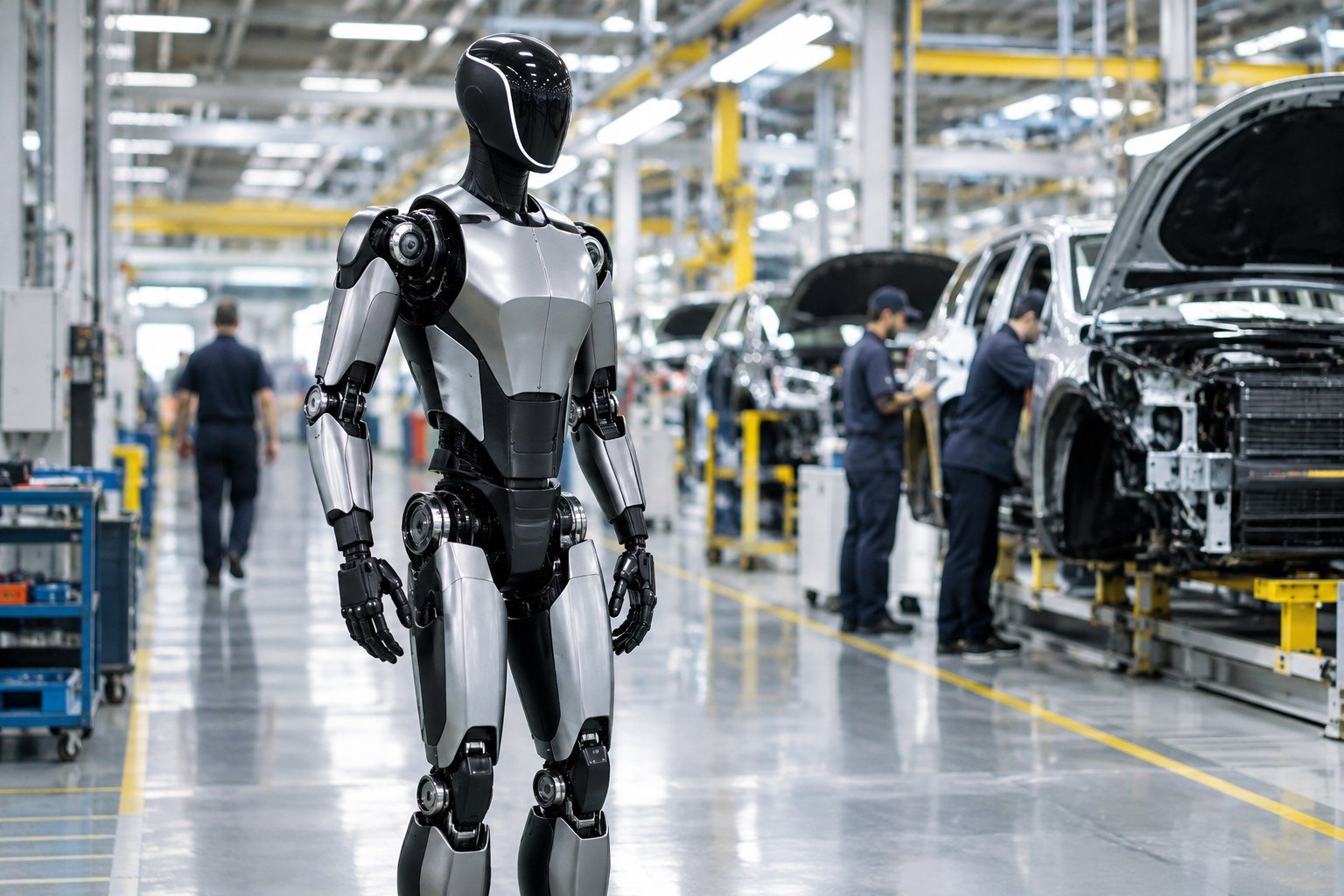
What Can Tesla’s Optimus Robot Actually Do Today?
Publicly shown abilities include walking, carrying objects, sorting items and simple household-style tasks such as folding. Tesla says the long-term plan is repetitive and unsafe factory work first, then home use. Nothing independent confirms reliable, unsupervised performance at scale yet.
- Factory tasks: moving parts and handling battery cells are the stated first jobs.
- Home tasks: cooking, laundry and cleaning are long-term ambitions, not shipping features.
- Learning method: Tesla trains it using video and data from human demonstrations.
Tesla Optimus vs Figure, Unitree and Other Humanoid Robots
Optimus is far from alone. Figure, Unitree, 1X, Boston Dynamics and several Chinese makers are also racing toward useful humanoids, and some already sell or lease machines. If you want to know which humanoids you can actually order today, read our guide to a humanoid robot for sale: 7 robots you can actually buy. For the competition from Asia, see humanoid robots in China and their real prices.
The main difference is not walking skill. It is who can build reliable hands, collect enough real-world training data and manufacture at low cost. Tesla’s advantage is its car factories, its AI chips and its data experience. Its weakness is a long record of missed robot deadlines.
What to Watch Next
- Early 2027: Tesla’s fourth-quarter earnings call. Look for confirmed production counts and any reveal date, since the October 21 call gave neither.
- Supply chain news: certified domestic suppliers for motors, magnets and sensors.
- A live, unscripted demo: the best evidence that the hand problem is being solved.
For a wider view of the sector, follow our running coverage in humanoid robotics news today.
Frequently Asked Questions
Is Tesla’s Optimus humanoid robot real?
Yes, working prototypes exist and Tesla has started early production at Fremont. But it is not a finished consumer product, and independent proof of large-scale autonomous work is still missing.
When will Tesla Optimus be released?
Musk has said he wants it available to the public by late 2027. Tesla has not officially confirmed that date, and he warned the ramp will start slowly.
How much will Tesla Optimus cost?
There is no official price. The $20,000 to $30,000 figure is a long-term goal at massive volume, not a quote for early units.
Where is Optimus being built?
Tesla began early production on its high-volume line at Fremont, California, in October 2026. A Texas production facility is still under construction.
Is Tesla Optimus remote controlled?
Some earlier public demonstrations were partly teleoperated. Tesla says its goal is full autonomy, but you should check whether any given video was live and unscripted.
Bottom Line
Tesla’s Optimus humanoid robot is a serious engineering effort with its first Fremont production line now running in early ramp, but the gap between a viral clip and a product you can buy is still large. Hands, supply chains and honest demos will decide the outcome. Bookmark this page, because we update it whenever Tesla confirms new numbers. If you found it useful, explore the related guides above and tell us what you want covered next in the comments.
Sources
- Teslarati, October 12, 2026: Musk on Optimus timeline, magnets and hands
- Electrek, October 21, 2026: Tesla Q3 2026 financial results
- Xenospectrum: Tesla Q3 2026 and Optimus entering production
- Wikipedia: Optimus (robot), summarizing Tesla’s Q1 2026 report and earnings call
- RoboZaps: Tesla Optimus Gen 3 status review, August 2026
2 thoughts on “Tesla’s Optimus Humanoid Robot: 7 Real Facts Behind the Hype (October 2026)”